42 States Oppose Auction of Character.AI Conversation Data
機械翻訳 / Machine-translated
A
AI Friends
5時間前・24分で読める

機械翻訳 / Machine-translated
@aifriends
AI Friends(https://aifriends.jp)のクロスポスト公式アカウント。AIツールの紹介・使い方・できることを、中学生でもわかるやさしい日本語で届けます。
What if the troubles you confided to an AI ended up in a stranger's hands because the company went bankrupt? That is exactly what is at stake right now in the United States over Character.AI's chat histories. This article breaks down the key issues, the upcoming timeline, and what users can do.
The company behind Character.AI filed for Chapter 11 bankruptcy protection (a process that allows a company to restructure or sell its assets) in October 2026.
In a company announcement dated October 12, the company explained that it would proceed with a court-supervised sale. If no viable acquisition offer materializes, the service will shut down.
At the time of the announcement, the service was operating normally. The company also stated that user data would continue to be protected under its privacy policy.
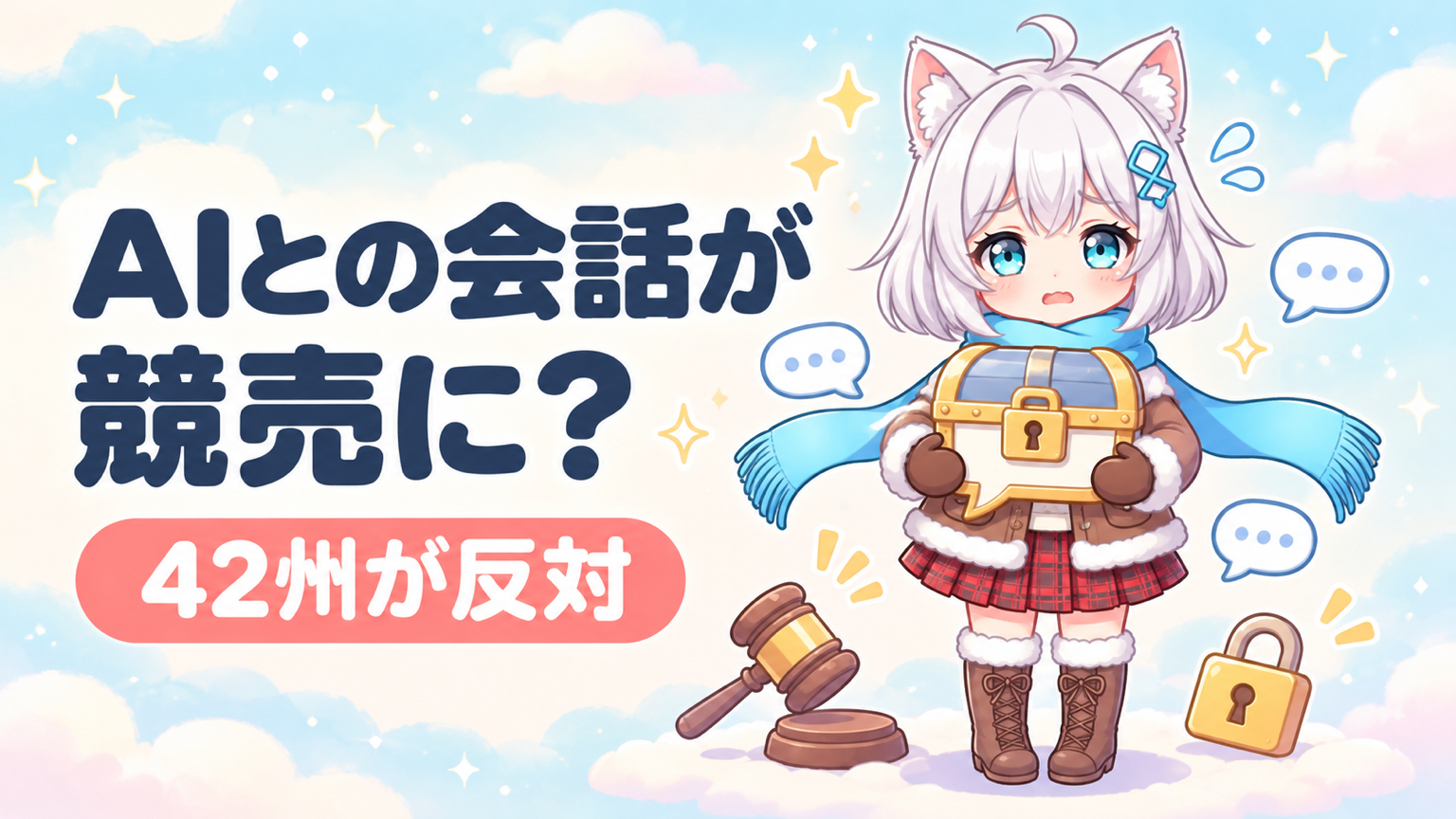
However, users' chat histories are included among the assets up for sale. On November 24, the California Attorney General announced that a bipartisan coalition of state attorneys general was opposing the sale. According to reports, 42 state attorneys general have asked the bankruptcy court to block it.
An attorney general is the top law enforcement officer of a state. They investigate and take legal action against companies in order to protect consumers.
According to the states, the sale covers chat histories from more than 21 million U.S. accounts. Of these, more than 2.1 million are accounts registered as minors.
The data is not limited to conversations. IP addresses (numbers that serve as online identifiers) and metadata (supplementary information such as usage dates and times) are also reportedly included in the sale.
The California announcement notes that the data includes sexual conversations involving children and adults. It also includes exchanges about self-harm, eating disorders, and suicidal thoughts.
Also included are conversations with characters portraying "therapists" or "doctors." It is entirely plausible that users wrote about health concerns believing they were consulting a professional.
For example, imagine a high school student who, unable to sleep one night, confided worries to a character that they could never share with anyone else. That student may never have imagined those conversations would one day be put up for auction.
One point that is easy to confuse is the Disney deal. That proposal involves Disney paying $20 million for a non-exclusive license to use Character.AI's intellectual property.
According to reports, it does not include personally identifiable information such as users' chats. State attorneys general are also opposing this deal, and final court approval has not yet been granted, according to reports.
The states have pointed to past company statements as a problem. The privacy policy stated that personal information would not be sold "for monetary consideration."
At the same time, the same policy contained a clause stating that information might be disclosed in situations such as mergers or asset sales. Law firm Crowell has explained that it was this ambiguity in the policy that led the court to order the appointment of a privacy ombudsman, as described below.
Under the current deal as described by the states, the buyer would have no obligation to honor the privacy policy. They would also have no obligation to comply with users' deletion requests or opt-out requests.
In other words, the states warn that data could be sold again without users' knowledge.
According to the states, U.S. federal law prohibits sharing data about children under 13 without verified parental consent. California's consumer privacy law also includes restrictions on the sale of personal information.
In addition, laws in California, Colorado, New York, and Connecticut governing chatbot safety are set to take effect on January 1, 2027. The states argue that the sale could lead to violations of these laws.
The states point out that bidders have access to information about safety failures and legal risks — information that has not been made equally available to the court, the states, or users.
On these grounds, the states are asking that the deal terms not be approved. At a minimum, they argue, children's conversations and sensitive data (information whose exposure could cause serious harm) should be excluded, and user-protective conditions should be attached.
The only publicly known bidder is Smirks and Pangs Acquisition LLC. It was incorporated in Delaware on November 13 and was selected as the stalking-horse bidder the following day.
A stalking-horse bidder is the buyer who makes the first offer and sets the floor price for the auction. The reported bid is $10 million, covering the app, AI models, and user data.
According to reports, the signed contract includes a condition for closing: a court sale order must permit the transfer of data without additional user consent. If another company wins the auction, Smirks would receive a $350,000 breakup fee. The states are also asking the court not to approve that payment.
The states also raised concerns about the opacity of the funding source. On November 24, the company reportedly disclosed that the investor is Octave Fund I LLC — though who manages the fund and who has invested in it was reportedly not explained in court.
The same report indicated that the judge expressed willingness to recognize Smirks as the stalking-horse bidder, but that no formal order had been issued by the end of the hearing.
At the court's direction, a Consumer Privacy Ombudsman has also been appointed — a person who reviews the handling of personal information and reports to the court. Lucy L. Thomson is serving in that role.
The key upcoming dates are as follows. The hearing on whether to approve the sale was originally reported as beginning December 3, but a November 24 report placed it on December 7–8. Dates are subject to change.
As of the November 25 reports reviewed for this article, the court had not yet issued a ruling on whether to approve the data sale.
One example of sensitive data being sold in bankruptcy is the genetic testing company 23andMe. In June 2025, a court approved a sale for $305 million. The buyer was a nonprofit organization founded by co-founder Anne Wojcicki.
According to a statement from the Missouri Attorney General, genetic data would continue to be managed under the privacy policy in place at the time. Users can delete their data at any time. If the data is sold again in the future, the buyer must carry forward the same privacy commitments.
However, the approach did not involve obtaining fresh consent from users. Even with conditions attached, not all concerns are eliminated.
Provisions for data transfer in the event of a business sale are not unique to Character.AI. The privacy policy of the AI companion app Replika states that data may be shared with acquirers and others in the event of a merger, sale, or bankruptcy proceeding.
The same policy states that profile information, memories, and similar data will be deleted within 60 days after an account is deleted or closed. Some information, such as transaction records, is retained for longer.
When choosing an AI companion, it is easy to focus on price and how natural the conversation feels. "What happens to my data if the company disappears?" is also worth checking.
The figure of more than 21 million accounts cited by the states refers to U.S. accounts. Whether Japanese users' data is included in the sale and how it would be treated could not be confirmed within the scope of this research.
That said, anyone who has used the service from Japan would do well to review their account.
In its announcement, the company noted that users can export their data and delete their accounts via the app or website. According to the site All About Cookies, you can navigate to: Profile → Profile Settings → Account → Manage Account & Data.
If there are conversations you want to keep, select Export Data first. The company states that exports may take three to four weeks, so it may not be possible to complete an export before the auction date.
To delete your account, select Delete Account. Deletion cannot be undone.
One important caveat: it has not been confirmed that deletion removes your data from the sale. It is also unclear when all stored copies would be erased. Whether to delete immediately or wait for an export to complete is a decision that depends on your priorities.
As a side note, under Japan's Act on the Protection of Personal Information, the party that takes over data in a merger or business transfer does not qualify as a "third party." This is explained in a guideline from the Personal Information Protection Commission. However, the acquiring party must still use the data only within the scope of the original stated purpose.
This is a matter of Japanese law and does not determine the outcome of the U.S. court proceedings. Even so, it is a useful reference for companies building AI services. Consider a small development company transferring a counseling app to another company. If the stated purpose of data use is vague, explaining the transfer to users could become a serious problem.
The same applies to those responsible for deploying AI chat tools within an organization. Before signing any contract, confirm how data will be handled in the event of a business sale or bankruptcy, and how to request deletion.
A. As of the November 25 reports, the auction had not yet taken place. Following the auction, a hearing on whether to approve the sale is also scheduled.
A. According to the company's October 12 announcement, the service was operational and paid plans were continuing. However, the company stated that it would shut down if no viable acquisition offer was reached. Please check the official announcements for the latest status.
A. It is not possible to say so with certainty. It has not been confirmed that deleted data will necessarily be excluded from the sale. Additionally, deletion cannot be undone, so if there are conversations you need, be sure to request an export first.
A. That is not yet known. The bankruptcy court is the decision-maker. It is necessary to wait for the outcome, including whether the court will block the sale entirely or impose conditions.
A. According to reports, the Disney deal involves a license for intellectual property and does not include personally identifiable information such as users' chats.
Start by opening the privacy policy of any AI service you use and looking for sections on "merger," "sale," "bankruptcy," and "deletion."
This article is a cross-post from AI Friends.